Podcast Transcript
This is The Lyme Plus Podcast, in association with Global Lyme Alliance.
Every day, someone in our community searches for hope, for answers for a lifeline, and so many of them found that lifeline in Global Lyme Alliance. This season, you can help us reach even more families through our Stronger Than Lyme campaign. If you’ve ever been touched by a story on this podcast, if GLA has supported you or someone you love, this is a moment to take action.
Go to gla.org to donate or start a fundraiser. Right now, thanks to a generous $50,000 match from the Bang the Drum Foundation, every dollar you give to GLA is doubled. That means double the research, double the patient support, double the chance to change someone’s life.
Thank you, and we wish you a healthy holiday season. The views expressed on Lyme Plus are those of the speakers and do not necessarily reflect the views of Global Lyme Alliance, Inc. or its affiliates.
The content is informational and not medical advice. Global Lyme Alliance does not endorse any specific product or treatment. Always consult with the doctor or other healthcare professional for diagnosis and treatment.
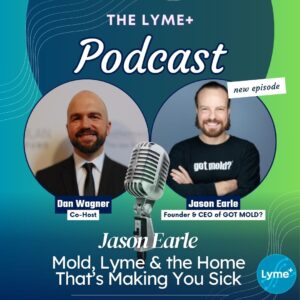
Hey everybody, this is Dan from the Lyme Plus Podcast. We have Kenzie Vath, my co-host on here today, and we have Jason from GotMold. Jason, we met at the 2024 Global Lyme Alliance Gala, and it was awesome being able to meet you.
Unfortunately, at things like that, I did not have enough time just to sit and talk to you for hours upon hours. It was one of the most interesting conversations I had when I was there in New York, and it was really cool getting to know you. We’ve chatted a little bit since then, and Kenzie and I were huge fans of your product and what you guys are doing, and we were just a huge fan of you coming on the podcast, and we all talk about what you do.
Jason, GotMold is the company. GotMold, what is GotMold? Where did that come from?
Then we can maybe get into a little bit of your story, and your childhood, and what you went through.
Sure. Well, first of all, thanks for having me and my sentiments. Exactly when it comes to us meeting and connecting at GLA.
I’ve been a big fan of your work, and of course of Kenzie’s work, and the whole Global Lyme Alliance team. I mean, I’ve been blessed to know Diane for a while, Diane Blanchard, and so I’m a big fan of the whole mission purpose. And it strikes home for me, of course, because I come to the mold business from personal experience, but I also had Lyme when I was a teenager, so we can dig into that a little bit, if you like.
Yeah, absolutely. So if you want to start GotMold, what is it and what does GotMold do?
Sure. I mean, I always say that our name is a question and the answer is our business, right? So our job here is to help people figure out whether or not they’ve got a mold issue, and then also, of course, what to do next.
So many people already know that they have a mold problem, they don’t necessarily know the extent of it, so that’s another question that we often help people answer. But most people come to this from, come to a concern about a mold problem with a tremendous amount of misinformation. They’re coming to it already misinformed, they’re coming to it from education, they’ve gotten from perhaps, you know, their mother-in-law or from Facebook, and, you know, these are generally not reliable sources when it comes to the subject matter.
So we spent a lot of time educating. In fact, I often say that we’re an education company that happens to sell a product as opposed to a product company that uses content marketing. And so, you know, most of what you’ll find on our website is actually, you know, things that help people navigate this very complex and often counterintuitive landscape.
So gotmold.com is our website. And there you’ll find that we sell an at-home test kit. It’s an air sampling test kit.
And it uses the same methodology that professionals use worldwide for testing particles. Of course, mold spores are particles. And so this is a way for us to be able to offer that kind of high quality professional testing at an affordable price.
And then in addition to the affordability and ease of use of it, we also have a really turnkey experience. So it makes it easy for people that are suffering, for example, from Lyme disease, who are often encumbered by cognitive impairment, as well as mold-related illnesses often comes with that too. And so we made it simple enough that people that are suffering from mold and Lyme can use it.
And then we partnered with the number one lab in the world, Urofins, so that you get results that you can count on. And also that you can rely on the turnaround time. So we have a very fast turnaround time.
So basically, it’s the highest quality at-home mold test kit available right now. And it’s really to answer the concern that most people have, which is that mold testing is expensive and it’s hard to know who to trust. So we worked really hard to fix those two things.
Yeah, absolutely. So what is the process for someone to be able to go get one of these kits and what do you do, essentially?
Yeah, so you can buy them. Oftentimes, people refer to us through their doctor, who is dealing with helping them navigate the mold or Lyme conditions or mold in Lyme. But we also are available on Amazon and gotmold.com.
So it’s a pretty simple process. Everything is baked in, lab fees, shipping, both ways, the whole thing. But again, behind that, so our report isn’t just a lab report.
It also contains, the third page contains sort of a launch pad, if you will. So we have links to find qualified inspectors and remediators in your area, through trade association to train and certify them. A self-assessment tool called Hayward Score, which is a free tool that gets you the ability to sort of fill out a survey of your home.
How old is your house? How was it built? What kind of systems you have, HVAC, what kind of heating and air conditioning systems?
And then you go through a series of questions around water events and things like that, and you get sort of a report card, if you will, with a numerical zero to 100 on essentially the health of your home with action steps. And that’s a free service through my friend Carl Grimes at Hayward Score. He’s one of the grandfathers of the industry.
And so we put that in there as a little added value, and as well as an ebook, which gives people 46 pages of inspection checklists and FAQs and all the things that we hear constantly from people that we’ve been educating around. And so the process, buying the test kits is easy, using it’s even easier. It’s only about 20 minutes if you sit down and actually go through the user guide and collect the samples, and the results are back in three business days.
So again, our tagline is real science, real simple. So we try to live to that.
I love that. Jason, I’m really curious. Many people that have been involved in the Lyme community, we know how impactful mold can be to the chronic illness community.
Can you share a little bit based on your education and knowledge of why mold is so bad with people with chronic Lyme?
Yeah, that’s a great question. Well, so there’s a few different things. There’s actually a big pile of things, but for the sake of simplicity, the best analogy I can make is the mold and Lyme essentially affect the same inflammatory pathways, and so which is predominantly cytokines.
And so when you have two of the same afflictions running down the same road, it’s like two tractor trailers going down a one lane road, right? Something’s going to give. And so essentially, you end up with this overwhelm.
There’s a bunch of different dysregulations that come from that, that affect the adrenal system, which also lead to emotional dysregulation, which is anyone who’s listening to this has been through it knows that that’s the hallmark of it. And so what you end up with is a situation where there’s this inflammatory condition that also leads to a shift and change in your nervous system. And so that is essentially why so many people have a hard time recovering from it, because it’s not something that just bounces back.
And so oftentimes what we see is people do a really good job of cleaning up their environment, let’s say. And they’re doing the necessary treatments for the Lyme, but they’re still just not getting better. They’re still having a really hard time with just basic day-to-day stuff.
And those people tend to do really well with neural retraining. So I’m kind of skipping ahead, it’s kind of sharing a little bit about the experiences that I’ve seen that really work for people. But basically, that’s the key is that you’ve got a double whammy of, you’ve got two illnesses that effectively amplify each other.
And so people don’t get better from Lyme if they got mold exposure. That’s really the bottom line. So it continues that inflammatory experience.
And similarly, people who have chronic mold exposure tend to be more susceptible to Lyme infections. So some people actually are not nearly as susceptible. And they tend to have a different terrain, if you will, metabolic terrain, different physical terrain.
But this is one of those things, mold and Lyme are kissing cousins for sure.
Yeah, that’s a good way to put it. So obviously, you have quite a passion for this, Jason. So where did this passion begin for you?
Well, when I was about four years old, I lost a lot of weight in a three week period. So my parents took me to the pediatrician. I was also having difficulty breathing.
And he said, you know, this is pretty serious. You should probably take him to Children’s Hospital, which was about an hour away. And it’s a renowned respiratory clinic.
So the initial diagnosis based upon the symptoms I was presenting with and my family history was cystic fibrosis. So needless to say, my parents were devastated by that, especially my father who had lost four of his cousins to CF before the age of 14. So this was actually something they had talked about.
This is a risk. This is before reliable genetic testing and those kinds of things. I’m 48 years old, right?
So they were shooting in the dark back then. So thankfully, after six weeks of crying, they were able to get a second opinion. And evidenced by the fact that I stand here, I did not have CF.
I had asthma, compounded my pneumonia, and allergic to every single thing they tested me for. So, in fact, it’s one of my formative memories. I remember being in, it’s like a papoose with an open back.
It’s actually a straight jacket for toddlers. I kind of wish I had one. I’ve got two toddlers.
But I don’t think that’s legal these days. But then they draw a grid on your back and test with the antigens. And so my dad said I look like a ladybug.
My back just swelled up with red, with dots all over it. So I lived on inhalers really until I was about 12, at which point I moved out of that musty old farmhouse. And guess what?
All my symptoms went away. So in fact, I’m no longer allergic to anything. I have not had to use an inhaler since I moved out of that house.
So it was that distinctive. It was now the symptoms didn’t immediately go away, but I’d never had to use an inhaler again. So that’s a pretty profound symptom relief.
And then a year after that, my mom actually died in that same house. And if we have time, we can talk about the mechanisms of this, but she actually committed suicide in that same house. She stayed behind.
I moved in with my father. And the science on that, at the time, she’s an alcoholic and that’s a complex situation, so nobody can really say what went on there. But what I do know from the emerging research is that the mold wasn’t going to help.
In fact, many psychiatrists and psychologists now that are in the know, refer to mold and, excuse me, depression and anxiety as inflammatory diseases. So, and in fact, some recent animal study research on the byproducts of exposure to the musty smell show that fruit flies stop producing dopamine. They stop reproducing.
They fly down instead of to light, so they essentially become depressed. And then also Brown University did a study in 2008 and found this, with 6,000 people, this huge study, found a strong correlation between mold and dampness and doors and depression. So, years later, I was able to get a better grip on what really probably was going on there.
Certainly a Venn diagram, I don’t think there was a direct, this causes that. Life causes a lot of that, but certainly the mold wasn’t helping. And so a year after that, I was diagnosed with Lyme disease.
And so that was back when it was very, very controversial. The doctor who diagnosed me was under siege by the AMA. So it was a very difficult situation, but it was going around my town.
We had a lot of deer. We lived in a rural area outside of Princeton, New Jersey. And so lots of my friends got diagnosed as well.
And that was tough because it was 30 pills a day. I was taking Biaxin by the bottle. I mean, it was just insane.
Three days on, three days off. And so I missed a ton of school, both because of my mother’s premature departure and Lyme, because it was just like an onslaught. And it forced me to drop out of high school.
They essentially told me I had to stay the rest of the year and then come back and repeat it, which made no sense because I was barely making it through the year as it was. So I ended up taking a job at the… Well, I was already working at the gas station.
I took full time hours at the gas station where I met a guy who recruited me to come work for him on Wall Street when I was 16. And so I ended up within the year actually becoming the youngest licensed stockbroker in history with a Guinness World Record. And then nine years later, I became disenchanted with the money for money thing and saw a lot of the people that I was working with destroying their lives through substance abuse and getting divorced and you name it.
And I thought, jeez, this is probably not really where I want to spend the next couple of decades. And I went on a walkabout, decided to go traveling for a while, sold everything I owned and put 20 pounds of stuff in a backpack. And while I was away, I was reading, I was in Hawaii for a spell, which I think Kenzie is on her way to go.
I am? I can’t remember. You are?
Yeah. So I was bouncing around the islands and I happened to be in Oahu and I was reading a story about the Hilton Kalia Tower, which is this iconic building on Waikiki Beach. If you see the old postcards, they’ve got like a rainbow on the building.
And so that building had been shut down for a mold problem for about six months when I got there. It turns out it was the biggest mold problem in history. I happened to be in the shadow of the building reading this article about this historic mold problem, knowing nothing about mold.
And I came across a story, a little sort of knockout in a little sidebar article about a guy who had gotten sick and blamed the mold in the building. He was 40 years old and he had developed adult onset asthma and all these allergies that he had never had before. And it caught my attention.
I thought, geez, that’s my life in reverse. I wonder if we had a mold problem. So I, of course, called my father from a payphone, which I’m sure is not there anymore.
And asked him if he thought we had mold and he just kind of chuckled. He said, of course, we had mold. We had mushrooms in the basement.
Why do you ask? Oh my gosh. So I said, well, do you think that’s what made me sick?
And he goes, well, it couldn’t have helped.
Mold exposure and Lyme disease can overload many of the same inflammatory pathways, like two tractor trailers on a one lane road. If you’re navigating Lyme and feel stuck despite doing everything right, your indoor environment may be worth investigating. The GotMold test kit helps you stop guessing and start knowing with professional air sampling methods, clear results, educational guidance, and legendary support to help you understand what your findings mean and what to do next.
Take the first step towards a healthier tomorrow today. Go to gotmold.com and use code Lyme10 at checkout to save 10%. Believe in the air you breathe.
But I immediately became impassioned or fascinated by the idea that the buildings that we live and work in can make you sick. That was a big idea for me. And thankfully, it’s now a big idea that’s kind of in the zeitgeist.
Back then, that was not a common concept. That was, we think about these buildings that we live and work in as these boxes that we store our stuff in, that we just move through the world and we buy them, we sell them, we renovate them, we do all these things. But we don’t think about them the way I do now, which is as an extension of your immune system.
I think of the buildings as an exoskin or an exoskeleton. And if a building gets sick, guess what? The people get sick.
And when the building heals, guess what happens? The people do too. So there’s a symbiotic relationship here.
And so we have to start thinking outside the box. I mean, that literally and figuratively, right? We have to start thinking about these boxes more, these buildings more of as a function of, like I said, our immune system.
And in fact, we are the immune system of the building. We’re the mitochondria. I could take you for a walk down through a metaphor here that will blow your mind, but we’re essentially the mitochondria inside this cell.
And when the building is damaged and when there’s the threat, we go into cell danger response, everything, the whole thing affects the mitochondria. And then we’re unable to heal. And then of course, the good news is, 20 years later, as I sit here talking to you, my fascination with the idea that buildings can make you sick has shifted to the idea that the buildings can, in fact, facilitate healing.
And so that’s sort of the arc of my career, as it’s gone from going into the business on the inspection side, and then eventually going into creating the GotMold test kit.
Yeah, that’s incredible.
I want to say, Jason, your story is fascinating, and I can only imagine I can sit here for hours and probably talk to you about your past and how you made all those connections. And even just you sharing, like dropping out of high school, going full time at the gas station, picking up and becoming a broker. I mean, a lot of people could probably listen to that and kind of figure out, like how did you get to where you are?
And it is that connection, that direct connection as a child, you know? And I’m super fascinated by you speaking about buildings as an extension to our immune system because as a developer, I feel the same. And I built my home from the ground up with knowing that my past was so impacted by my environment that I wanted a fresh environment to live within for my optimal health.
So I thought about every aspect from water filtration to air filtration to crystals and portals and all these things, some woo-woo and some realistic, right? Science data behind it to ensure that my environment was safe for my body because I knew coming in with sponic illness, having Lyme, mold is part of that, peeling the onion and finding that many people with Lyme have mold or molds have Lyme, right? Absolutely.
And so love what you’re talking about and that. And I’m curious with that extension of, you know, the building being that, that could be protection or could be hurting you. What is the first steps that you would tell somebody that’s living in their home that may be suspecting mold?
Obviously, we want to get a test, right? But what would be some of the symptoms that they should be suspecting mold?
So, when it comes to testing, my suggestion is, and this is very counter to what you might think, I don’t tell people to run right towards testing. Although, I do believe that since we’re all going to end up with a colonoscopy in our 40s, it’s probably along those lines. You may not want to test your house, but you probably should.
You know, just before we get into the what should you look for, you know, about 35% of Americans suffer from chronic systemic inflammation and about 47% of homes, according to Lawrence Berkeley Labs have a mold or moisture problem of significance. Nobody knows what that Venn diagram looks like, but I would say that there’s a pretty heavy overlap there. And so what I suggest is that if you’re having any symptoms at all, and I mean, you know, as simple as headaches, difficulty concentrating, you know, fatigue, any sort of emotional dysregulation, obviously anything allergic, right?
So hay fever, these kinds of things, you’re going to want to look at mold. You know, the other thing is anything inflammatory. So the thing is that the mold is an inflammatory, and it compounds other inflammatory compounds.
And so when you think about what does inflammation do? Well, I mean, any one of the hundred different autoimmune diseases we now have in the books are inflammatory, they’re inflammation based, right? So what we typically see is that people who have any sort of underlying illness and underlying autoimmune disease, that will flare up, right?
So if you’ve got joint pain suddenly, if you have any symptoms that get better when you leave the building, that is a major red flag. And unfortunately, many of us are leaving a building that’s got a problem, going into a building that’s got another problem, because, and we can go down this rabbit hole a little bit later if you want, but to talk about mold without talking about VOCs is kind of malpractice in my business, because mold produces VOCs, volatile organic compounds, and most of us are living in buildings that have a VOC problem, because of either the age of construction or renovations, not to mention personal care products, and our cleaning products, and our furniture which we buy from China, which all evaporates into our home, and all these things are in these boxes that are super tight for energy efficiency, but that means that we’re re-breathing that same air 20,000 times a day. And so, mold is one of the big violators that produces VOCs, but we also are doing this with our man-made applications, if you will.
And so, they are together reinforcing each other, because of course, chemical sensitivity is another hallmark of Lyme disease and mold sickness. And so, the question is, which came first, the chicken or the egg? Oftentimes, a mold exposure leads to chemical sensitivity.
Oftentimes, chemical exposure leads to mold sensitivity. And so, these things are just swirling about, but they’re all overlapping. Again, Venn diagram, right?
So, when you’re talking about what people should look for, essentially, if you see something, smell something, or feel something, do something. So, if you see something, that’s any signs of moisture, right? A mold problem is a moisture problem.
Mold does not grow in the absence of moisture. And so, what we’re looking for are subtle signs in some cases, right? You might see a condensation around a window, right?
That’s a sign of high humidity. That means if you got condensation there, you may have condensation elsewhere, and that’s where mold will grow. So, you’re looking for water bugs, rust, stains, discoloration of any sort, peeling paint, bubbling paint, especially around windows and penetrations, sweating pipes.
If you ever see the trim pulling away from windows or the trim pulling away around the baseboard, that’s due to expansion and contraction at different rates, which usually means something got wet and swelled up, and then it dried back down. So, you start to see those things separate. So, you want to keep your eyes peeled for any signs of moisture.
The reason that that’s so important is because mold grows very quickly. So, within 24 to 48 hours, mold can grow. So, it’s really fast, and most people are not aware of it that quickly, so they don’t have a chance to stop it.
Within 72 hours, anything that gets wet and stays wet should be treated as if it’s moldy according to the industry standard. So, it’s really a short time frame. By the way, mold is only covered by insurance.
Water damage is only covered by insurance up until 72 hours afterwards, you’re on your own. So, if you have a water damage event, you have to move on that very quickly. Otherwise, it’s a cash pay, you got to bring in the specialist, and it’s very expensive.
So, you really want to get to it while it’s early, so that if it is insurable, you can ring that bell. So, the first one, right, if you see something, and obviously, if you see the visible mold, right? If you see any sort of discoloration that may look somewhat geometric, looks like sometimes it may even look, if you take a flashlight, and this is what I encourage people to do, and we walk you through this in our e-book, to do an inspection in your home, and use the flashlight at a little bit of an angle, and you can see the textures change.
You’ll see that what you think is dust actually starts to have these little circular shapes, and that’s called, those are colonies. So that’s what we’re looking for, is any sign of moisture. The second one is, if you see something, if you smell something, the musty odor is a big deal.
It has long been dismissed as an aesthetic nuisance, right? Gram is basement smell. In fact, some people think about this kind of nostalgically, right?
I mean, in some cases, the musty smell feels like, hey, it’s the cabin from the camp I went to when I was a kid, or our vacation home. So there’s a strange Pavlovian association sometimes to the positive with that stuff. But the current research on this is that this is neurotoxic.
The musty smell is essentially the digestive byproduct. Some people call it mold burps, some call it other effluents. And so really, it’s mold digesting your home and you’re inhaling the byproducts of it.
And some of these are carcinogens. Benzene, for example, is a common microbial VOC. But they all have the ability to trigger an immune response within sensitive individuals.
And so you’ll commonly see people that have a chemical sensitivity respond very strongly to the musty smell. But even people who are not sensitive will experience things like headaches, cognitive impairment, and things like that. In fact, the research on this that’s coming out is really fascinating around the mechanism of impact.
People tend to think about mold as being an allergen, of course, and toxic, and in some cases it is. Of course, it’s inflammatory and in some cases it can be infectious. But what many people call a toxic response turns out to be an inflammatory response.
I’ll unpack that for a quick second. In your face, there’s nerves called the trigeminal nerve, the cranial nerves, and the nerve endings are in your eyes, mouth, and jaw. They’re there to sense heat, cold, and pain primarily, but the nerve endings are also chemo sensory.
They are chemical sensors. This is like primal stuff, okay? This is your spidey sense.
When you have become sensitized, these become irritated, and so they are specifically triggered by pungent VOCs. Of course, the musty smell is pretty pungent, right? By the way, the musty smell is comprised of dozens of chemicals, so it’s not just one, but it will irritate the trigeminal nerve, which triggers a cytokine response.
So what you just have, what you end up with is this inflammatory response that many people will call a toxic response. In fact, get treated for mold toxins when really what they’re doing is breathing in and being exposed to this microbial scent, which by the way can occur below the odor threshold. So the olfactory nerves, the olfactory scents and nerves weave in with the trigeminal nerve and share information.
So you can actually end up with this detection happening below, but when you can’t necessarily smell it. That’s why you’ll see some people who are super sensitive walk into a room and go, oh, can’t be in here. I’m ready to go.
And then they blow up, right? And then they’re like, what the hell is going on here, right? No one else has this problem.
I’m the only one with this problem. And what it looks to be is that this is just a hyper reactive. This is the nervous system on high alert.
And so that can be tuned back down, doing things like Primal Trust and DNRS and these other modalities, which will dial that back down. But the musty smell, my point is, it’s a long way to get there, is that it is no joke. If you smell it, you have it.
The question is, where’s it coming from? And that’s the key element here is, in fact, I pioneered the use of mold sniffing dogs. I skipped over my mold inspection career, but we pioneered the use of mold sniffing dogs.
And they actually, that’s what they look for, is the scent that’s being produced by active growth. And then we can pinpoint it, and then we can surgically extract it without having to tear apart walls haphazardly. And so it’s very, very effective.
And so that’s been a major focus of mine for the last 23 years, the musty smell. It’s kind of a weird obsession, I know, but that’s really, truly what we’re working on. A mold sensor, we’re really close to being able to do this electronically.
And so that’s pretty exciting. But the musty smell is the second thing you need to look out for. And when you smell that, you need to find the source of the moisture and stop it.
So, right, so the first one is if you see moisture, okay, you got a problem, you got to fix that problem. Number two, if you smell it, find the source of the moisture, that’s the key element here. And then if you feel something, and that goes back to the symptoms we talked about, which is typically gonna show up as, you know, the upper respiratory and headaches, nausea, dizziness, fatigue, difficulty, constipation.
Asthma, specifically, I think is a really great trigger that you alluded to too, as a young child. I think a lot of kids suffer from asthma and they don’t realize it’s mostly allergy-based and they get put on all these inhalers, but they don’t, the parents aren’t educated to realize, like, they don’t need these inhalers, it’s just fixing the problem, you know.
Absolutely. Yeah, in fact, the data on that is really interesting too. There was a Swedish study, Swedish or Danish, it doesn’t matter, it was a Scandinavian study, and they found that kids that are exposed to the mussy smell early on have twice the risk of developing asthma later in life.
And so, yeah, and in fact, EPA Berkeley Labs did a pretty big study and they found that of the 24.6 million asthmatics out there, about 25% of them are mold and dampness related. So, you know, it’s a big deal. And what they find is that in homes with asthmatics, that there are very low cost solutions that you can usually implement to get that under control.
Obviously, you need to dehumidifier, small remediations, air purifiers, bedding encasements. Yeah, bedding encasements are a big deal, too, because of dust mites. So, you know, it’s not just mold, right?
You can’t really have this conversation about mold without talking about the other dampness-based allergens, like dust mites, without talking about VOCs, because, of course, it produces, like I said before, it produces VOCs, and so all of these things are part of the puzzle. I feel like mold is like the gateway drug, right? It gets people to talk about air quality, because you can see it, unlike most other air quality problems.
You can smell it, unlike things like radon, or dust mites, or these kinds of things. VOCs tend to be something that people actually kind of like. Your house is freshly painted.
It feels good. It smells good at the gas station, but you shouldn’t probably spend too much time doing that.
Yeah, exactly. Why do people like the smell of gas? I’m one of those people.
I don’t know, but I’m guilty.
Yeah. I heard something like pregnant women, too. They love that smell of bleach or something, and it’s because you’re low on a particular mineral, and that’s the body’s response of needing that smell.
It’s very weird. But I think you’re 100% right that it’s that gateway. People may have heard of mold or toxins.
They get in to get your test or get a test, and they have a positive result. What would be the next step they should take? What would be your educational response for them of like, okay, this is what’s next?
Well, so here’s the real problem with the mold industry, is that it’s very poorly regulated where it is regulated, and the quality of the mold professionals out there is honestly terrible by and large. There is an industry standard, but it’s followed intermittently, sort of like when it’s convenient. And so it’s not easy to say, well, go hire a professional, even though that’s oftentimes what you need to do, finding a qualified, reputable, trustworthy one is probably the hardest part of this whole process.
So what we encourage people to do is take as much control as possible yourself. And that’s why we have our e-book, which you can find at the welcome page that we made for this show, which is gotmold.com/lymeplus, and that’s spelled out L-Y-M-E-P-L-U-S. And there you’ll find a free copy of our e-book and at discount coupon for 10% off of our test kits.
But if you can take as much control back as you can in this process, which means gathering some samples on your own, doing the inspection with the e-book, with the guidance of our e-book. And then the key element here is always being a moisture sleuth. That’s the thing.
People are freaked out about mold. Be freaked out about moisture problems.
Yeah. Oh yeah.
You know, that’s the key here. That’s nobody is actually, mold is a symptom of a moisture problem. In fact, let me, I’ll walk you through what you should do, but I wanna talk a little bit about the way I see mold as inflammation in the building in a minute, because I think that gives people a little bit more context.
I think it makes it more real. Moisture problems are tricky because they come in at least two different forms. They come in liquid and they come in gas form, right?
Humidity. And so oftentimes the diagnosis of a moisture problem does require a professional. And so this is where people should get an education if they can.
In fact, on our website and on our learning center, we have a whole thing about how to diagnose your home for moisture problems, the tools you need, all that stuff. We really want people to learn how to do this. I think this is as fundamental as learning how to tie your shoes, learning how to jumpstart your car, although very few people know how to do that these days anymore.
But you really have to dial in your focus on moisture control. So that means essentially, maintenance is key. You have to understand that water gets in mostly from rain, and of course from leaks within the building.
And then of course, humidity comes from poor ventilation and from activities you maybe shouldn’t be doing indoors, like drying clothes indoors and things like that, lifestyle things, cooking without exhaust vents. So it’s complex. The sources are varied.
Sometimes people have too many aquariums or they overwater their plants. I mean, there’s just every house is completely different. And so there’s no fixed way to help people really diagnose it other than to say, your job as a person who lives in buildings and breathes air, is to be vigilant about moisture control.
Be vigilant about controlling it when you have a leak or a flood, clean it up quickly, and then pay attention to the things that could lead to that. And if you do that, you’re miles ahead of the pack. But then, again, keeping your senses tuned
And this is the other thing. Keeping your senses tuned means you have to trust yourself. And that is a hard thing, especially when you’ve been gaslit, and you’ve been told that your symptoms aren’t real.
And this is typical with mold and Lyme patients, where they’re told that they’re full of it, that they should go take some aspirin, get some rest, all this kind of crap. So, you get trained to not trust yourself. And so, what I encourage people to do is get to the place where they can trust themselves again, and tune in to your senses.
And if you see something, smell something, or feel something, do something. And sometimes taking that action is the thing that people need to develop that, to get the positive reinforcement. That feeling of, see, I was right about this, may not always be a source of joy, because you’re right about something you don’t want to have.
But, you know, oftentimes, what I find is that people tend to, people who think that they know where the problem is in their house are usually right.
Yeah. Yeah. That’s a really good way to put it.
I want to come back to a quick thing you mentioned at landing page on your website for Lyme+. Just go through that one more time so the listeners know what, know kind of what’s going on with that.
Sure. We create these landing pages for every podcast I’m on, and so gotmold.com/lymepluswilltake you to a page where there’ll be a link to this show in case you want to go back to it, and a copy of our e-book which is called How to Find Mold, pretty self-explanatory, and it’s filled with a bunch of FAQs, as well as a bunch of inspection checklists to walk you through your own home. Sort of giving your building a physical, if you will, right?
And then there’s some additional resources in there about how to hire an inspector and how to hire a remediator, and these kinds of things that are very common questions and sources of concern for most people. We get a lot of really positive feedback about that e-book. And then we also have a coupon there for anyone who wants to get a test kit for 10 percent off, and there’s a coupon code there.
If you just want to go to gotmold.com, you can use the code LIME10.
And so that’s just our way of being able to, and of course, anyone has any questions at any time, you can go right to our homepage and drop. We have a little contact form there, and we have a legendary support team. We answer all those questions pretty promptly.
Very cool. Awesome. Well, I think that might be kind of a good area in the podcast, and Kenzie, do you have any questions for Jason before we hop off?
I have a lot, but I think we’re going to have to set up another time to dive in. I really want to dive in more to your story and, you know, some more education and research around the mold space. But thank you so much, Jason, for being on today and sharing a lot of insight, good quality insight for those that are, you know, that are ill and they’re still trying to find what’s going on, you know, and we do need to consider our buildings that we work in and live in are part of that equation.
So thank you.
Absolutely. Thank you for having me.